Why Do Stars Twinkle (but Planets Don't)?
 📷 Sindre Fs · Pexels
✦ Key takeaways
- Twinkling happens in our atmosphere, not in the star; from space, stars appear steady.
- Layers of air at different temperatures bend and shift the star's light, making it flicker.
- Planets do not twinkle because they are small nearby disks, not points, averaging out the turbulence.
- Twinkling grows stronger near the horizon, where light crosses a thicker, more turbulent layer of air.
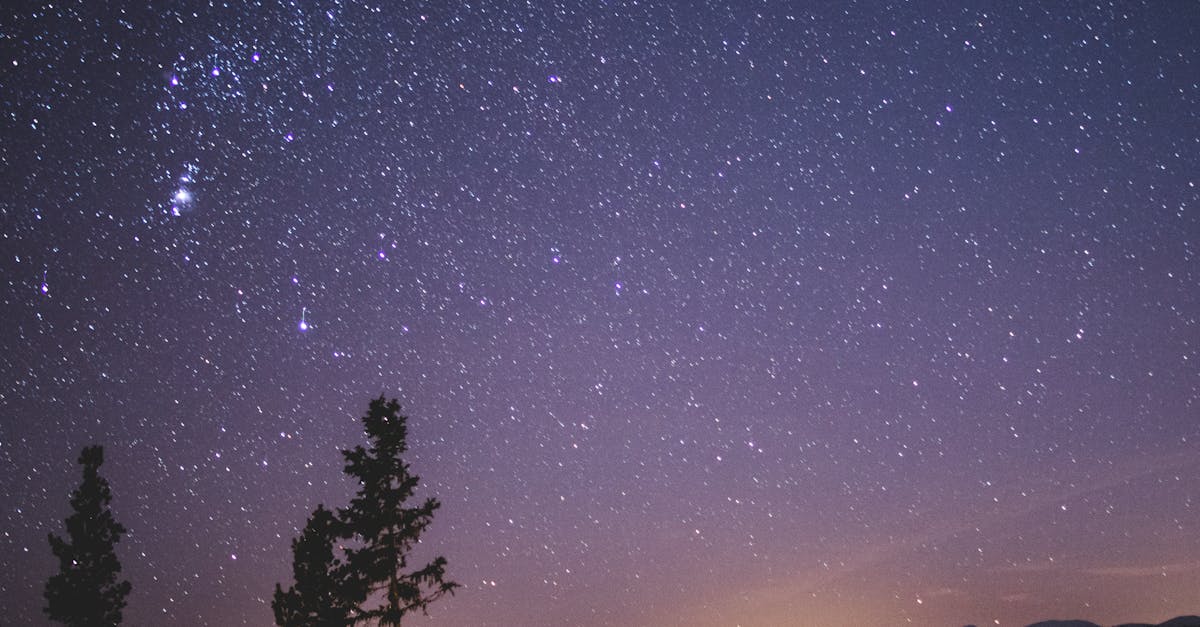
Songs have been sung to the twinkling star, and children draw it with rays shooting out as if it trembles. But the truth that may surprise you is that the star itself does not tremble or flicker at all. A star is a steady, calm lamp out in space, and the twinkling we see does not happen there, light-years away, but right here above our heads, in the thin layers of air surrounding our planet.
Let me take you along the journey of a single starbeam, from the moment it set out hundreds of years ago until it reaches the retina of your eye, so we can discover exactly at what point that enchanting flicker begins, and why it marks out stars but not planets.
Personal Budget Planner
Plan income & expenses, see your savings rate & 50/30/20 — live charts.
The Journey of Light Through a Sea of Air
A star's light crosses vast distances through empty space in a perfectly straight line without any disturbance. It stays steady and stable throughout its long journey, right up to the final moment when it strikes Earth's atmosphere. Only here, in the last few dozen kilometers, do the troubles begin.
Our atmosphere is not a calm, uniform medium but a moving sea of air layers that differ in temperature, density, and pressure. Warm air is less dense than cold air, and each layer bends light at a slightly different angle, exactly as a pencil appears to bend when you dip it in a glass of water. As these layers shift and ripple constantly, the path of the starbeam curves right and left from one instant to the next.
The result is that the beam reaching your pupil jumps a little away and back, and its brightness changes up and down within fractions of a second. Your eye translates this rapid dance into a shimmering flicker. This is what astronomers call 'seeing,' or atmospheric turbulence, and it is the number-one enemy of sharp astronomical images taken from the ground.
Why Don't Planets Twinkle?
Here comes the loveliest part of the story and its strongest proof. Look at the sky one night and you will notice that some bright points twinkle violently while others glow with a calm steadiness. Those steady ones are most likely planets such as Jupiter, Venus, and Mars, not stars. So why the difference?
The reason lies in distance and apparent size. Stars are so far away that they appear to us as infinitesimally small points of light, like a single dimensionless light source. When the air churns in front of this lone point, its entire beam is deflected all at once, so we see a clear flicker.
Planets, by contrast, are relatively close, so they are in fact small disks with an area, even if too small for the naked eye to resolve clearly. This disk is made up of a great many neighboring points of light, and each point twinkles independently at a different instant. When your eye gathers the light of all these points together, their vibrations cancel one another out on average, so the planet appears steady. It is the same idea that makes the noise of a whole crowd more even than the voice of a single person.
And Why Does It Intensify Near the Horizon?
Try observing a star close to the horizon and then compare it to one high overhead; you will notice the low star twinkles far more violently, sometimes even flashing in shifting colors between red and blue. The reason is that its light crosses a far thicker layer of atmosphere when you look sideways, passing through a greater volume of turbulent air than when you look straight up.
This thick layer does not merely bend and shift the light; it also splits its colors like a prism, so blue is scattered more and the star sometimes shows rapid colored flashes. Sirius, the brightest star in our night sky, is famous for this colorful performance when it hangs low near the horizon, so much so that some have mistaken it for a strange flying object.
A Practical Sign Under the Sky
This difference has a lovely practical use that amateur astronomers know well: if you want to tell quickly whether the bright point you see is a star or a planet, watch its steadiness. A star blinks and shivers, while a planet glows with a calm, steady light like a hanging lantern. This simple rule has been known for thousands of years, and it helped ancient cultures distinguish the 'wandering' planets from the 'fixed' stars long before the telescope was invented.
The strength of the twinkling itself carries useful information too: on nights when you see stars blinking very violently, the atmosphere is highly turbulent, and it is a poor night for telescope observing no matter how clear the sky. But when the stars look calm and almost steady, that is a night of 'excellent seeing' that every astronomer wishes for, because images of planets and fine objects come out sharp and clear.
How Do Astronomers Defeat the Twinkling?
Since twinkling is an enemy of precise observation, scientists have devised clever tricks to overcome it. The first is to build major observatories atop high mountains and in deserts, where the air is thinner, more stable, and less turbulent. But the cleverest solution is 'adaptive optics,' in which the telescope measures the shimmer of a reference star's light hundreds of times per second, then deforms a flexible mirror by exactly the opposite amount to cancel the turbulence in real time, restoring a sharp image.
The ultimate radical solution, though, is to escape the atmosphere entirely. This is why the clearest cosmic images are captured by space telescopes such as Hubble and James Webb, soaring above all the layers of air. There, in the still of space, stars never twinkle; they shine as fixed, sharp points, just as they truly are. So remember, the next time you see a twinkling star: you are not watching the star tremble, but watching your planet's air breathe.
A Myth Worth Correcting
Many people think that the color of a twinkling star, or the strength of its flicker, tells us something about the nature of the star itself, as if it were about to explode or was pulsing. This is not true; the twinkling we see with the naked eye is a purely atmospheric effect made by our own air, not a property of the star. It is true that some stars really do vary in brightness for internal physical reasons, but their change is slow, measured in hours and days, not the rapid blinking you see over seconds. That quick flicker is always the fingerprint of our atmosphere alone.
Sources
NASA — material on astronomical seeing and adaptive optics. Encyclopaedia Britannica — entries on 'Twinkling' and 'Astronomical seeing.' European Space Agency (ESA). National Geographic.